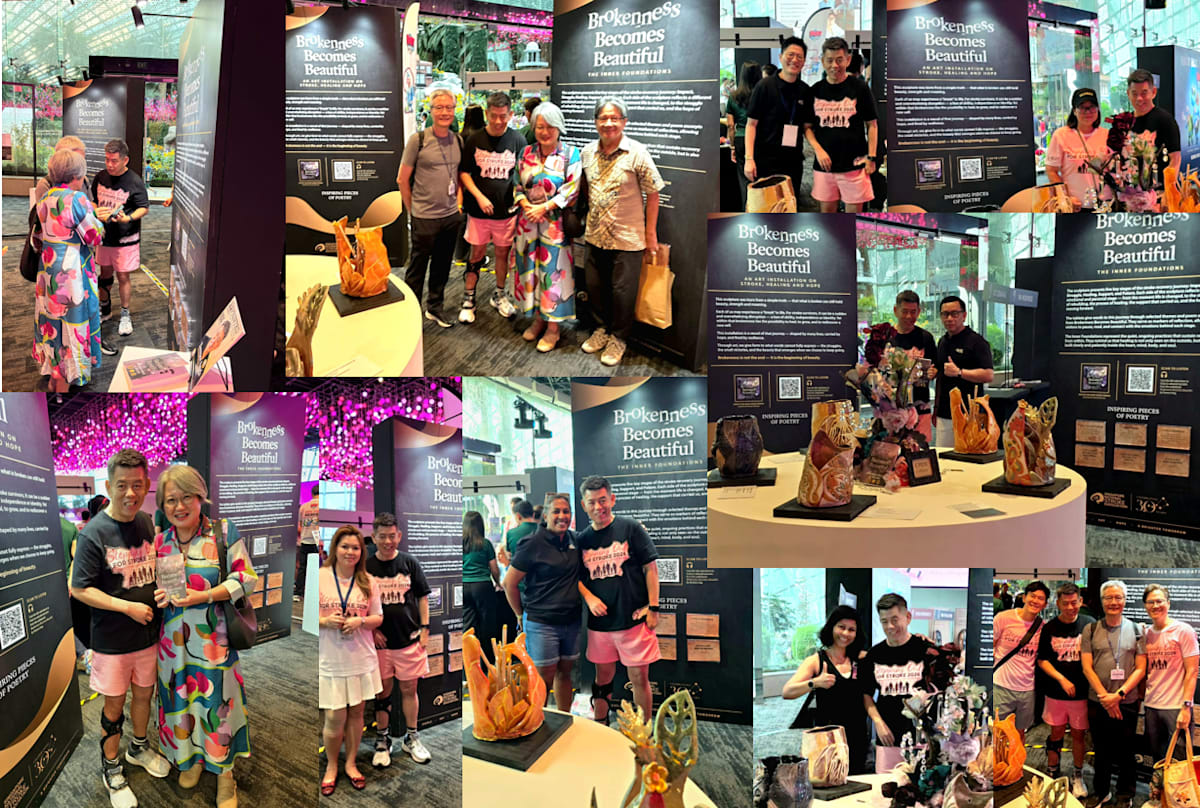
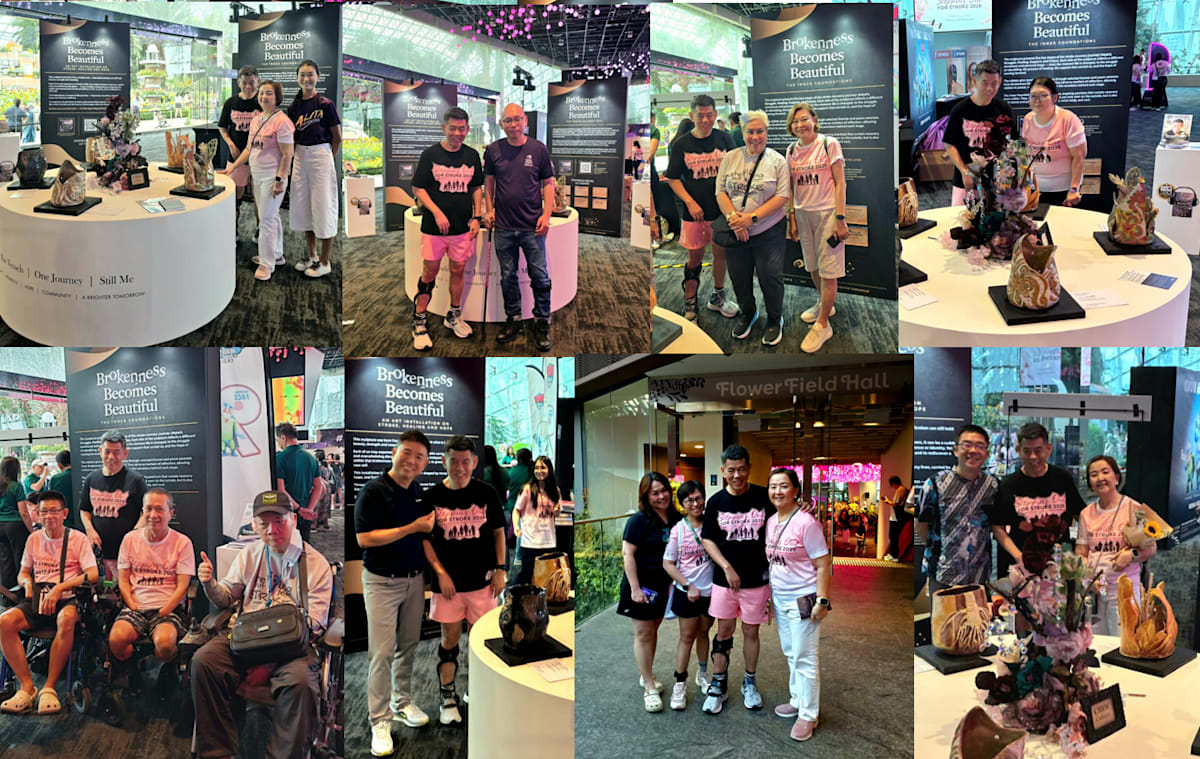
On Saturday, 31 October 2026, the Singapore National Stroke Association (SNSA) celebrated its 30th anniversary with Stepping Out for Stroke 2026 (SOFS) at Flower Field Hall, Gardens by the Bay
For me, it was more than an anniversary celebration. It was a reminder of what can happen when a community comes together to believe in the potential of people whose lives have been changed by stroke.
Having been away from SNSA's activities for close to a year, returning to the community was particularly meaningful. It was heartening to see familiar faces and witness the tremendous effort that had gone into organising the event, especially the Survivor Arts Exhibition.
And what an exhibition it turned out to be!
I must confess that, leading up to the exhibition, I had my share of misgivings.
I had a particular vision of how my exhibition booth should look and how my work should be presented. Perhaps I was too insistent on having things done my way. Looking back, I realise that my persistence may have caused Angela, Olivia, the exhibition contractor, and Kevin considerable stress and frustration.
For that, I must give Angela, Olivia and Kevin even greater credit for their patience, understanding and professionalism. Despite the challenges and differing expectations along the way, they remained committed to bringing everything together. Their dedication and perseverance made the final outcome all the more meaningful, and I am truly grateful for their efforts.
The final outcome exceeded my expectations.
Seeing everything come together so beautifully brought an overwhelming sense of relief, appreciation and gratitude.
In my opinion, the Survivor Arts Exhibition was the highlight of this year's SOFS celebration.
But the credit belongs to the people who made it happen.
As Angela rightly acknowledged, this milestone was the result of teamwork, dedication and the collective commitment of SNSA's Executive Committee (EXCO), Arts Committee, organisers, contractors, volunteers and, most importantly, the stroke survivors whose artworks gave the exhibition its heart and soul.
To Angela, Olivia, Kevin and everyone involved, thank you for your patience, perseverance and hard work.
What you created was far more than an exhibition space.
You created a space where stroke survivors could be seen, heard and celebrated for what they can do, rather than defined by what they have lost.
Stroke can change a life in an instant.
It can take away abilities we once took for granted. It can shake our confidence, challenge our identity and leave us questioning what the future holds.
But stroke does not take away our humanity, imagination or capacity to grow.
That is what made the Survivor Arts Exhibition so meaningful.
It provided a platform for survivors to uncover hidden talents, rediscover forgotten passions, explore their potential and showcase their abilities.
More importantly, it encouraged them to dare to dream and find the courage to try again.
Art does not demand perfect speech, flawless movement or physical strength.
Sometimes, all it asks is that we begin.
A brushstroke. A piece of clay. A photograph. A poem.
Each becomes an expression of something deeply personal.
Each tells a story that deserves to be heard.
And each reminds us that recovery is not merely about regaining what was lost. It is also about discovering new possibilities, uncovering potential we never knew existed, and developing talents and abilities we may never have imagined we possessed.
Amid the activities and celebrations, there was another unexpected moment that touched me deeply.
During the Piloxing session, Rasidah Caudal led several SNSA members and members of the audience through an energetic workout.
At two different moments during the session, Rasidah called out my name, offering words of encouragement.
It was a simple gesture, but one that meant a great deal to me.
What made it especially memorable was the cool-down session.
As the song "This Is Me", one of my all-time favourites, began playing, Rashid called out my name again.
For a brief moment, it felt almost as though the song was meant for me.
I was genuinely touched.
Perhaps Rasidah did not realise just how much that moment meant to me.
But "This Is Me" has always resonated deeply with my journey after stroke. Its message of self-acceptance, courage and embracing who we are, despite our imperfections and struggles, reflects so much of what I have experienced over the past six years.
After stroke, it can be difficult to accept the person we have become, especially when we are constantly reminded of the abilities we have lost.
Yet somewhere along the journey, we begin to realise that we do not have to be the person we once were to have value, dignity and purpose.
We are still ourselves.
Changed, perhaps. But no less deserving of being seen, heard and accepted.
Thank you, Rasidah, for those unexpected words of encouragement.
You may not have realised it, but you gave me a moment I will remember for a long time.
Because after everything that stroke has changed in my life, I can still say: This is me.
One of the most meaningful experiences for me was collaborating with fellow stroke survivor Wendy Lim on our installation, *Five Vessels | One Journey | Still Me*, inspired by my book *Brokenness Becomes Beautiful: Inspiring Pieces of Poetry*.
Wendy brought our shared journey to life through five extraordinary clay sculptures.
Each vessel represented a different stage of life after stroke, from the world we once knew to the sudden disruption of stroke, the struggles of rebuilding, the strength found through others and the hope of a brighter tomorrow.
The cracks, imperfections and kintsugi-inspired details were not flaws to be concealed.
They were part of the story.
What moved me most was how Wendy translated emotions that are often difficult to articulate into something tangible.
Her passion, determination, resilience, vulnerability and inner strength seemed to radiate from every sculpture.
There was pain in the clay, but there was also courage.
There was brokenness, but there was beauty.
As someone living with aphasia, I understand how difficult it can be to express what is happening inside us when words no longer come easily.
Through this collaboration, my poetry gave words to our experiences, while Wendy's sculptures gave those emotions form.
Together, we created something neither of us could have achieved alone.
I am especially happy that this experience has helped reignite Wendy's passion for ceramics and renewed her confidence in working with clay.
To my wonderful partner-in-crime, Wendy, thank you.
Your sculptures did more than complement my poetry. They brought the spirit of my book Brokenness Becomes Beautiful to life.
And perhaps that is one of the greatest gifts of this exhibition. It was not simply about displaying what we had created.
It was about rediscovering what we were still capable of becoming.
Another deeply moving moment was meeting Ms Sylvia Lim, Chairperson of the Workers' Party and Guest of Honour at SOFS 2026.
During her sharing, she spoke about her late father, Mr Lim Choon Mong, who had lost his ability to communicate following his strokes.
Her story struck a deep chord in me.
Her father was a man of words. Someone who enjoyed expressing his views, articulating his thoughts and engaging in lively conversations.
He had played a significant role in shaping Sylvia's political awareness and understanding. Around the family dinner table, he would discuss politics, policies and issues affecting Singapore. While other family members were less inclined to participate, Sylvia would engage passionately in those discussions with him.
Their relationship was not without its challenges, but she had once affectionately described how they eventually became "the best drinking buddies".
Imagine, then, what it must have meant when a man who had spent his life communicating so passionately could no longer express himself as he once did.
And imagine what that loss meant to a daughter whose relationship with her father had been enriched by so many conversations over the years.
I could not help but feel the weight of that experience.
Having suffered a haemorrhagic stroke in 2020, I, too, lost much of my ability to articulate my thoughts through speech.
Aphasia changed the way I communicate with the world.
There are thoughts I want to express, emotions I want to share and conversations I wish I could participate in more freely.
The words are sometimes there in my mind, but getting them out can be an enormous struggle.
For people who have never experienced aphasia, it can be difficult to appreciate the frustration, isolation and emotional toll of being unable to communicate.
And the impact extends beyond the survivor.
Families and caregivers also experience profound changes.
The spontaneous conversations, familiar exchanges, shared jokes and simple everyday interactions that once connected people can become difficult or, at times, impossible.
Yet these struggles often remain invisible.
Aphasia does not mean we have nothing to say. It means the world needs to learn how to listen.
Sylvia's sharing reminded me why greater awareness, empathy and understanding of aphasia are so urgently needed.
Behind every person struggling to communicate is someone with thoughts, feelings, memories, knowledge and a lifetime of experiences.
Their voice may have changed.
But the person is still there.
This is why the Survivor Arts Exhibition means so much to me.
For people whose lives have been profoundly affected by stroke, art offers another language.
A language that does not always require words.
It allows us to express the emotions we sometimes struggle to explain.
The frustration of losing our independence.
The grief of losing parts of our former selves.
The fear of an uncertain future.
But also the courage to begin again, the determination to keep going and the hope of discovering renewed meaning and purpose.
The artworks on display were not simply expressions of creativity.
They were ART from the HEART.
Art born from pain and struggle.
Art shaped by resilience and determination.
Art inspired by love, acceptance and hope.
Together, they formed a tangible expression of unity, community spirit and the extraordinary strength of people who continue to rebuild their lives after stroke.
The exhibition also carried an important message to the wider community.
Stroke survivors are more than their disabilities.
We have abilities to discover, contributions to make and dreams still worth pursuing.
What we need are opportunities, encouragement and communities willing to see our potential.
We need platforms that foster greater empathy, understanding and inclusivity.
And we need people who believe that life after stroke can still be meaningful, fulfilling and beautiful.
As SNSA celebrates three decades of supporting stroke survivors and caregivers, I hope the Survivor Arts Exhibition will become a lasting part of its journey.
Not merely as an annual showcase, but as a continuing platform for survivors to rediscover their identity, rebuild their confidence and find new purpose through creative expression.
Because sometimes, the most powerful stories are told without a single spoken word.
Looking back, I am grateful for the experience, the friendships, the challenges and the lessons learned along the way.
This exhibition reminded me that beautiful things rarely happen through individual effort alone.
They emerge when people come together, embrace differences, overcome challenges and believe in something greater than themselves.
My heartfelt thanks to SNSA, its EXCO, Arts Committee, the organising team, contractors, volunteers, sponsors and every survivor who contributed to making this exhibition possible.
And to Wendy, thank you for sharing this journey with me.
Perhaps the greatest lesson is that while stroke may change the direction of our lives, it does not have to determine how our stories end.
We may not have chosen what happened to us.
But we can still choose what we do next.
I would like to end with a poem from my book, Brokenness Becomes Beautiful, which I believe captures the spirit of this exhibition and the courage of every stroke survivor who dares to begin again.
this chapter of your life
isn't what you expected
you don't like the scenario
you blame the producer
you blame the actors
but remember
you're the director
and this is your story
make the next chapters
worthy of winning awards