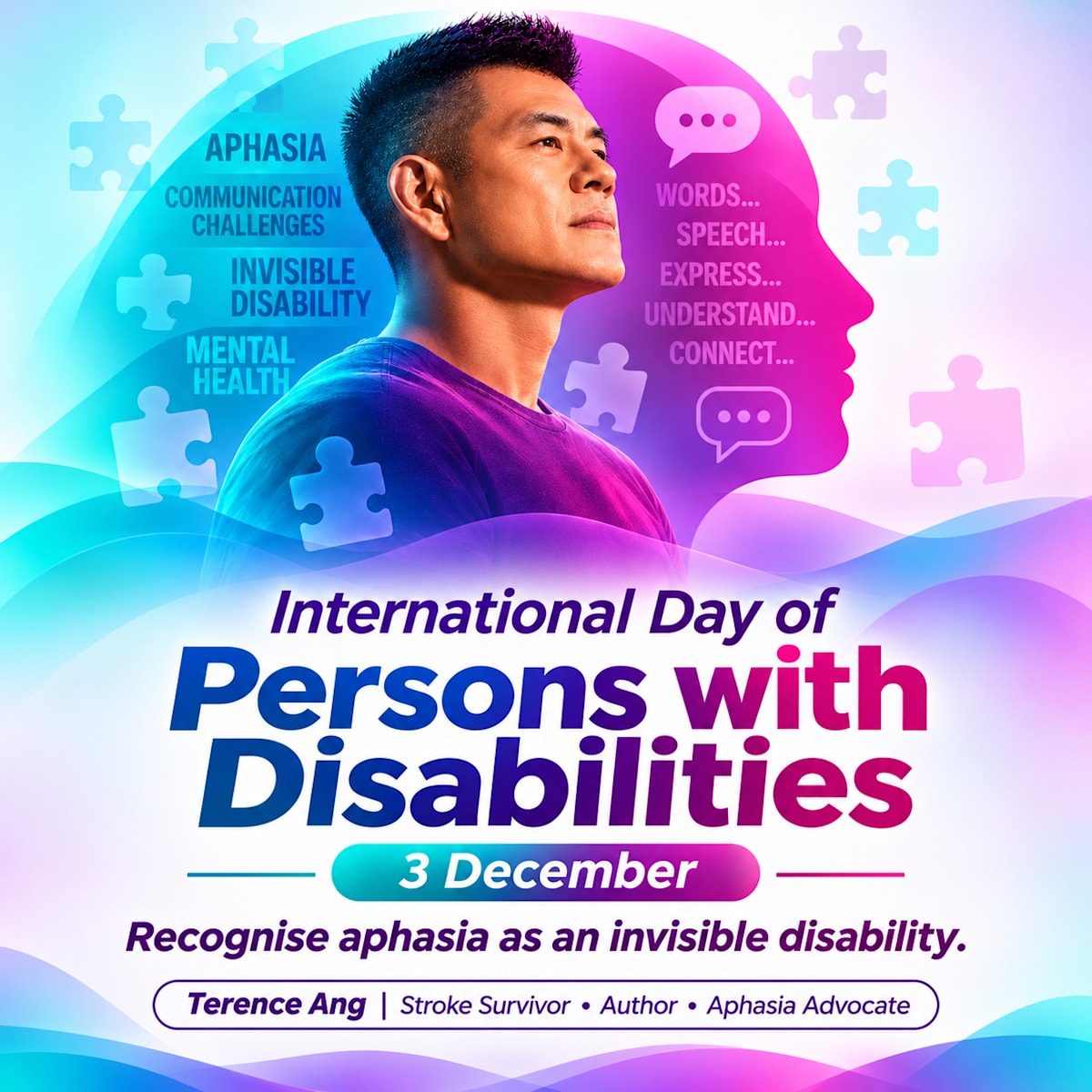
Losing the ability to communicate should never mean losing the right to be heard, understood, supported or included.
Six years ago, a stroke changed my life. Living with aphasia has made me realise that some of the most profound challenges of disability are the ones society cannot see.
Aphasia is more than a communication difficulty. It can affect confidence, independence, employment opportunities, social relationships and a person's sense of identity. Behind the daily struggle to find words often lies an invisible battle with frustration, isolation, anxiety and emotional distress.
Yet, these psychological, emotional and social consequences remain insufficiently recognised.
As we approach the International Day of Persons with Disabilities on 3 December, I am calling for greater recognition of aphasia as an invisible disability in Singapore.
Awareness must translate into policy. Recognition must translate into rights, resources and meaningful support.
I urge Singapore's policymakers, relevant ministries, healthcare institutions and disability agencies to work together towards concrete policy action:
🔹 Formal Disability Recognition
Review Singapore's existing disability definitions and eligibility frameworks to explicitly recognise aphasia and acquired communication disabilities.
🔹 Accessible Mental Health Care
Develop inclusive psychological and mental health services that accommodate the unique communication needs of people living with aphasia.
🔹 Long-Term Rehabilitation and Community Support
Establish sustainable post-discharge rehabilitation pathways that address communication, emotional well-being, social reintegration and quality of life beyond physical recovery.
🔹 Equitable Access to Disability Support
Review eligibility criteria for financial assistance, employment support, vocational rehabilitation and community-based programmes.
🔹 Communication Accessibility as a Policy Priority
Incorporate communication accessibility into healthcare, public services, workplaces and national disability inclusion initiatives.
🔹 Investment in Assistive Technology and AI
Support research, funding and pilot programmes that harness artificial intelligence and assistive communication technologies to empower people with communication disabilities.
These are not requests for special treatment. They are calls for equitable access, dignity and equal opportunities.
Through my writing, poetry, AI voice technology and advocacy, I have found new ways to make my voice heard. But meaningful inclusion should not depend solely on an individual's determination to overcome barriers. It must also be supported by policies and institutions committed to removing them.
My Call for Policy Action
I respectfully call upon the Ministry of Social and Family Development (MSF), the Ministry of Health (MOH) and SG Enable to initiate a coordinated policy review in 2027, with the participation of healthcare professionals, researchers, caregivers and people with lived experience of aphasia.
I propose that this review establish a clear roadmap, with measurable objectives and implementation timelines, to formally recognise acquired communication disabilities and improve access to disability services, psychological care, rehabilitation and employment support.
People living with aphasia must be included in these policy discussions. Our lived experiences should help shape the policies that affect our lives.
Let 3 December 2026 mark not simply another day of awareness, but the beginning of a concrete commitment to policy action in Singapore.
We may struggle to find our words, but we should never have to struggle to find our place in society.
Recognise Aphasia.
Bridge the Policy Gaps.
Turn Awareness into Action.
Leave No One Behind.
#InternationalDayOfPersonsWithDisabilities #IDPD2026 #AphasiaAwareness #InvisibleDisability #DisabilityRights #PolicyChange #DisabilityInclusion #MentalHealthAwareness #CommunicationAccessibility #AphasiaAdvocacy #Singapore #EveryVoiceMatters #LeaveNoOneBehind