Last weekend, I had the privilege of spending time with the Boston Aphasia Community Group—though for me, it happened at a rather unusual hour.
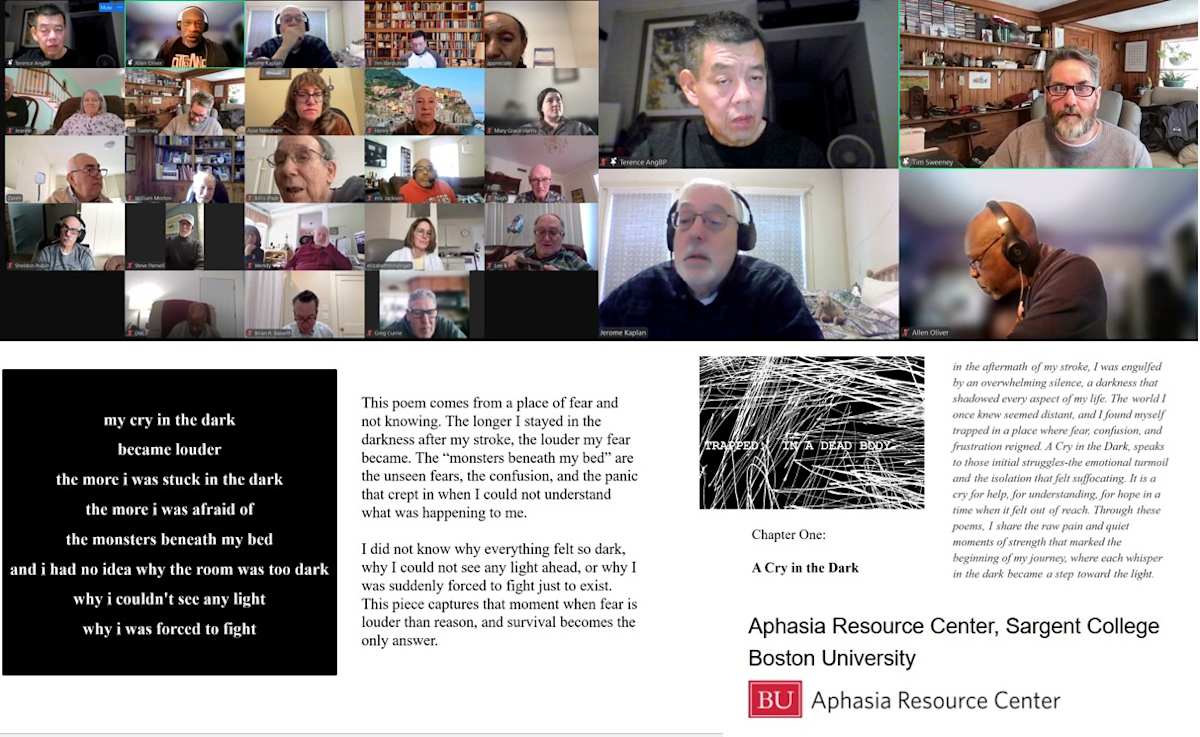
The Boston Aphasia Community Group has been quietly building a caring and supportive space for decades. Founded in 1990 by speech-language pathologist Jerome Kaplan together with individuals living with aphasia, the group has grown into a close-knit community rooted in understanding, respect, and shared experience. What began as regular in-person gatherings at Spaulding Rehabilitation Hospital gradually evolved, and the group later became part of the Aphasia Resource Center at Boston University’s Sargent College of Health and Rehabilitation Sciences.
For more than thirty years, the group has offered connection, encouragement, and practical support to people whose lives have been shaped by aphasia. Today, it continues to meet online twice a month, creating a welcoming space where people come together to learn from one another and to be heard.
Through a contact in the United States, I was introduced to Jerome Kaplan—Jerry, as everyone knows him. Last December, Jerry reached out to ask if I would be interested in doing a virtual visit with the Boston Aphasia Community Group. I was genuinely excited by the invitation and agreed without hesitation.
Last Saturday night—or rather, early Sunday morning for me—I logged into Zoom at midnight Singapore time. When the group meets at 11:00 a.m. in Boston, it is exactly 12:00 a.m. on my side of the world. Thankfully, I am not an early-to-bed person, so midnight was still very doable.
I was deeply honoured when Jerry asked if I would read one or two poems from my book Thunderstroke prior to the meeting. This was something I had never done before. Given my stuttering and speech challenges caused by aphasia, reading poetry aloud has always felt daunting and remains a sensitive area for me since my stroke.
Still, I saw this as an opportunity—to challenge myself and take a step toward becoming more confident in my speech. To support myself, I prepared a PowerPoint deck to guide me through the reading of selected poems from Thunderstroke. As the book has three chapters, it felt meaningful to read one poem from each chapter.
That morning marked many firsts for me.
It was the first time I read poems from Thunderstroke aloud to a group.
It was the first time I presented to participants from the United States via Zoom.
And it was the first time I presented at the wee hours of the morning.
As I prepared my slides, many thoughts ran through my mind.
Would they understand what I was saying?
Would they understand my Singlish?
Would they like my poems?
Could they feel my words?
And many other worries that tend to surface before moments like this.
The meeting began almost exactly on time. As participants joined the Zoom call, the numbers slowly grew until there were more than twenty people present. It reminded me very much of the Aphasia SG Zoom meetings back home. There was something familiar and comforting about the atmosphere. The group was warm, respectful, and deeply attentive whenever someone spoke. Almost immediately, I felt at ease.
Jerry hosted the session and introduced James and me to the group. Shortly after, I was given the “stage” to read my poems. James supported me by providing context and background about Thunderstroke and each chapter. After I read a poem, he also offered a short summary connecting the poem to the broader themes of the book.
When I finished reading all three poems, I felt a quiet sense of pride. I had done the best I could in that moment, and I had followed through on something that once felt impossible.
What surprised me most was how deeply the reading resonated with the group. Much of the remaining time was spent in discussion—about the poems, about aphasia, and about personal experiences. Several participants shared their own stories, and some expressed appreciation for the work I had shared. It meant a great deal to know that my poems could connect with a group of people I had just met for the very first time.
This midnight rendezvous reminded me once again why I want to continue reaching out to the community. If my books or presentations can truly make a difference to someone—if they help someone feel seen, understood, or less alone—then it is not all in vain.
#Aphasia #StrokeRecovery #Thunderstroke #PoetryAsHealing
#AphasiaAwareness #LivedExperience #FindingMyVoice
#CommunityConnection #DisabilityVoices #HealingThroughArt