Last Book. New Direction.
We usually think of an anniversary as something to celebrate — a wedding, a milestone, a happy occasion.
For me, 25 August is a different kind of anniversary.
Six years ago, on 25 August 2020, I had a stroke.
Sometimes it feels like a lifetime ago. At other times, I can still remember how suddenly everything changed.
There was the life I knew before the stroke, and then there was the life I had to learn to live after it.
These six years have not been easy. There have been periods of grief, self-pity, frustration, depression and anger. There were many moments when I wondered why this had happened to me, and whether I would ever feel like myself again.
Even today, I am still learning how to live with the things that stroke and aphasia have taken away or made more difficult.
But when I look back now, I also realise how much these six years have given me.
I discovered writing.
Somehow, the person who struggled to find his words went on to write seven books. If you had told me before my stroke that I would one day become an author, I probably would have laughed. It was never part of my plan.
Perhaps that is one of the strangest lessons life has taught me — sometimes a completely different path only appears when the one you were travelling on suddenly disappears.
This year, I wanted to mark my sixth stroke anniversary in a way that feels especially personal to me — with the release of my latest book, Brokenness Becomes Beautiful.
In many ways, this book is a reflection of where I am now.
For a long time, I think I saw recovery as trying to get back to the person I was before my stroke. I wanted to repair what had been broken and recover what I had lost.
Six years later, I see things a little differently.
I am beginning to understand that not everything broken has to be put back exactly as it was before.
Some things may never return. Some wounds remain. But brokenness does not mean that life has lost its value.
There can still be growth. There can still be hope. There can still be purpose. And sometimes, there can even be beauty in becoming someone you never expected to be.
That, perhaps, is what Brokenness Becomes Beautiful means to me today.
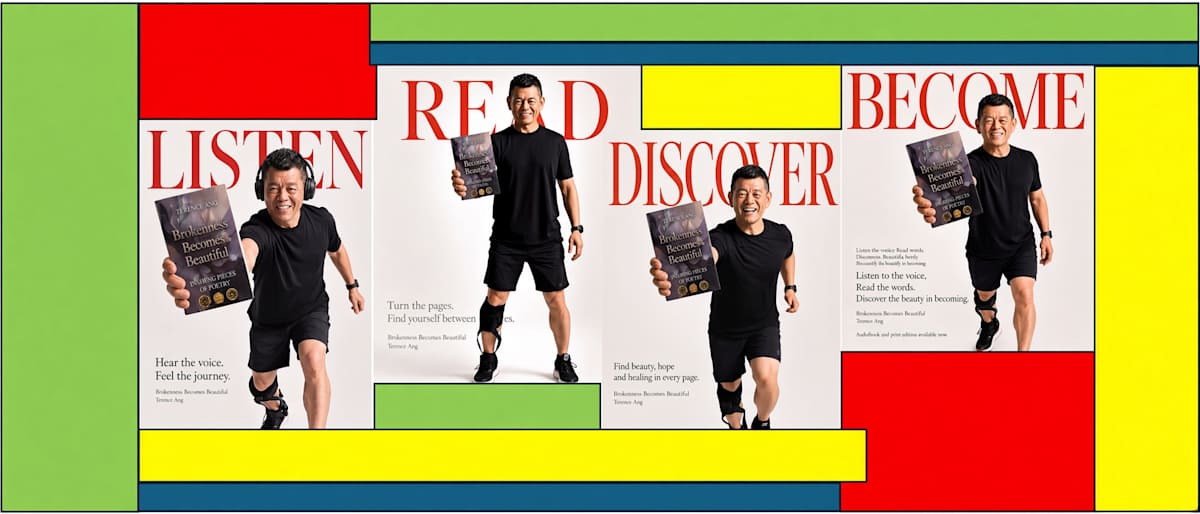
The four images I am sharing with this post — LISTEN, READ, DISCOVER and BECOME — were created around this journey of mine.
LISTEN — hear the voice and feel the journey.
I have had to learn to listen differently — to my body, to the people around me, and also to the voice inside me that was still there even when I could not always express it.
READ — turn the pages and find yourself between the lines.
Writing has helped me look at my own life differently. I began to see beyond what stroke had taken away and to recognise what might still remain, and what might still be created.
DISCOVER — find beauty, hope and healing in every page.
Along the way, I discovered things I never expected — writing, advocacy, new friendships, and a different sense of purpose.
And then there is BECOME.
For me, becoming is not about reaching some perfect version of recovery.
It is simply about continuing to grow into the person I am now, while remaining open to who I might still become.
I have also learned just how important people are.
I am deeply grateful for those who stayed beside me through the difficult days, who were patient when communication was hard, who encouraged me when I doubted myself, and who continued to believe in me even when I was struggling to believe in myself.
After six years, I wouldn't say that I have overcome stroke.
Maybe what has changed is that I have slowly learned to come to terms with it.
Not surrender. Not acceptance in the sense that everything is fine.
Just an understanding that this is part of my life now — and that I still have a choice in what I do with the life that remains ahead of me.
Stroke has placed limitations on my life, and I cannot pretend otherwise. But having limitations does not mean I have to limit what I am willing to try.
I don't know whether I will write another book.
For the first time in several years, I am comfortable not knowing.
What I do know is that I want to continue advocating for people living with aphasia.
I want more people to understand that when someone has difficulty speaking, it does not mean they have nothing to say.
I want to lend my lived experience to research, because I have come to realise that research can do much more than help people understand what people like me go through after leaving the hospital. It can help shape what comes next — new approaches to rehabilitation and medical intervention, better care and support, greater empathy, more accessible facilities and a more inclusive society.
And perhaps lived experience can contribute something that data alone cannot: an understanding of what it actually feels like to rebuild a life after stroke.
I also want to continue exploring AI and technology, because I believe we are only beginning to understand what they might make possible for people living with aphasia.
Perhaps AI can become more than a tool that helps us find words or communicate. Perhaps it can support rehabilitation, help us regain independence and confidence, make it easier to reconnect with others, build relationships, return to work and participate more fully in society.
Technology has already helped me do something I once thought impossible — reclaim something as personal as my own voice.
That makes me curious about what else might be possible, not only for me, but for others living with aphasia.
And when something new comes along that might help me further this cause, I want to remain open enough to say, why not give it a shot?
Six years ago, I had no idea where this road would take me.
The truth is, I still don't.
There may be difficult days ahead. There may also be possibilities I cannot yet see.
And perhaps I don't need to have everything figured out.
Life is an adventure, after all.
So I will keep exploring — new avenues, new opportunities and new directions.
And if somewhere along the way I can help create a little more understanding, a little more awareness and a little more possibility for someone else living with aphasia, then perhaps this unexpected journey of mine can continue to mean something.
Maybe that is what this sixth anniversary means to me.
Not celebrating what happened on 25 August 2020.
But recognising how far I have travelled since.
The broken pieces are still part of me.
I am simply learning that they do not have to be the end of my story.
And perhaps, in the end, that is what these six years have really been about:
not returning to who I was, but continuing to become who I can still be.
Brokenness Becomes Beautiful is available to listen and read:
🎧 Listen on Spotify
https://open.spotify.com/show/21oplbL4B6rwlzinhYijCa
🎧 Listen on ElevenReader
https://elevenreader.io/.../broke.../pj_zMGD4XLzw6afOPbau1JJ
📖 Ebook on Amazon
https://www.amazon.com/dp/B0HC87NGHP
📕 Paperback on Amazon